



Did you know that America turns 250 years old this year?
Most of us know that this was a big birthday for America, but do you know how independence actually came to be?
The Resolution to Declare Independence
On June 7, 1776, Richard Henry Lee, a delegate from Virginia, stood in front of the Second Continental Congress and officially introduced a resolution that “these united colonies are and of right ought to be free and independent states.” At this point, the colonies had been at war with Britain for a little over a year after the Battles of Lexington and Concord, but they were not fighting for independence. They were fighting over the ability to govern themselves as they had been for the last 150 years.
Many of the delegates at the Second Continental Congress believed that what Richard Henry Lee was proposing was too drastic of a measure. The vote for independence was scheduled for July 2nd so the delegates could go home to discuss with their states on what they should do.
The Committees
In the meantime, three committees were formed in response to Lee’s Resolution: a committee to draft a declaration of independence, a committee to plan on forming foreign alliances, and a committee to plan the form of a confederation.
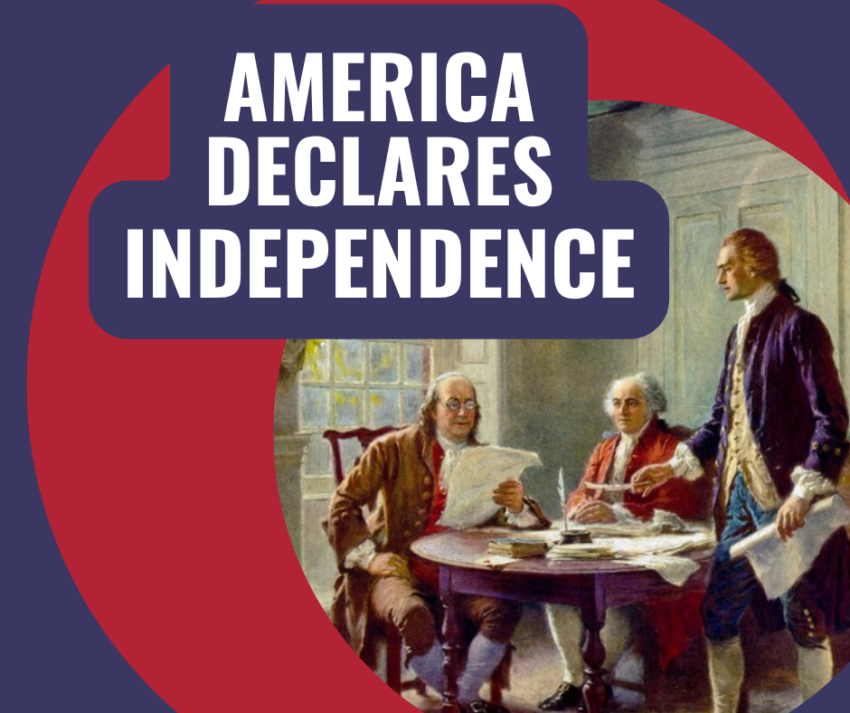
The committee designated to draft a Declaration of Independence, the Committee of Five, was made up of Thomas Jefferson, Benjamin Franklin, John Adams, Roger Sherman, and Robert R. Livingston.
Thomas Jefferson, though only 33 years old and the youngest member of the Committee of Five, was selected to write the words of the Declaration because he had a knack for explaining things in a way everybody could understand.
On July 2nd, Congress voted on declaring independence from Great Britain. John Adams wrote to his wife that “It will be celebrated by succeeding Generations as the great anniversary Festival. It ought to be commemorated as the Day of Deliverance by solemn Acts of Devotion to God Almighty. It ought to by solemnized with Pomp and Parade, with [Shows], Games, Sports, Guns, Bells, Bonfires and Illuminations from one End of this Continent to the other from this Time forward forever more.”
Signing the Declaration
Despite popular belief, the Declaration was not signed on July 4th. The vote for independence took place on the 2nd and Congress voted on the final wording of the Declaration on the 4th.
Timothy Matlack was chosen to handwrite the final copy because of his clear and elegant penmanship and the delegates actually began signing it on August 2nd, 1776.
The plan for making treaties was approved in September 1776 and the plan for confederation was approved the next year in November 1777.
Leaving a Legacy
The men who signed the Declaration knew that there was no backing down after signing their name. What they were doing was technically considered treason. However, they truly believed that what they were fighting for was worth it and not a single one ever retracted their commitment.